Meal Management Planning and Nutrition Service Using Localized Dietary Guidelines and Artificial Intelligence
Mobile Application | Nutrition | AI
Mobile Application | Nutrition | AI

KainPo is an intelligent mobile application designed to help Filipinos optimize their meal plans using FEL (Food Exchange List) methodology. The app leverages Gemini AI to provide personalized meal recommendations based on nutritional requirements and preferences, while Supabase ensures secure data management and user authentication.
Best Research Poster
IURS 2026
6.49 / 7.00 Overall Ratings Across General Users
User Evaluation
Best Research Paper Nominee - IT Category
IURS 2026
In the Philippines, patients frequently abandon dietary plans from Registered Nutritionist-Dietitians (RNDs) because they lack the time and health literacy to translate technical instructions into practical, everyday meals. To bridge this gap, we developed KainPo: a digital platform that automates meal planning. By converting complex clinical guidelines into actionable, culturally appropriate daily meals, KainPo significantly reduces the user's cognitive load and improves long-term nutritional adherence.
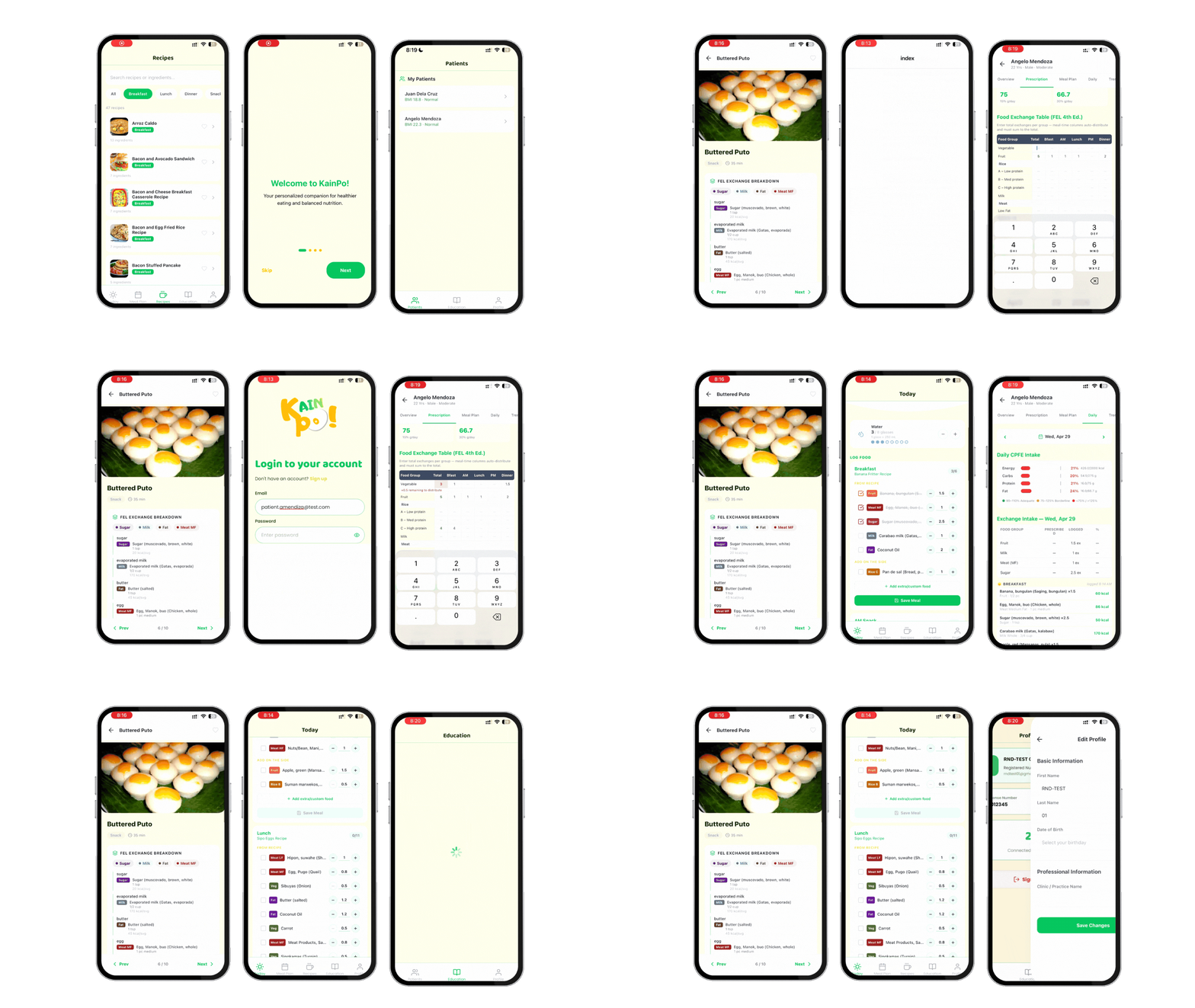
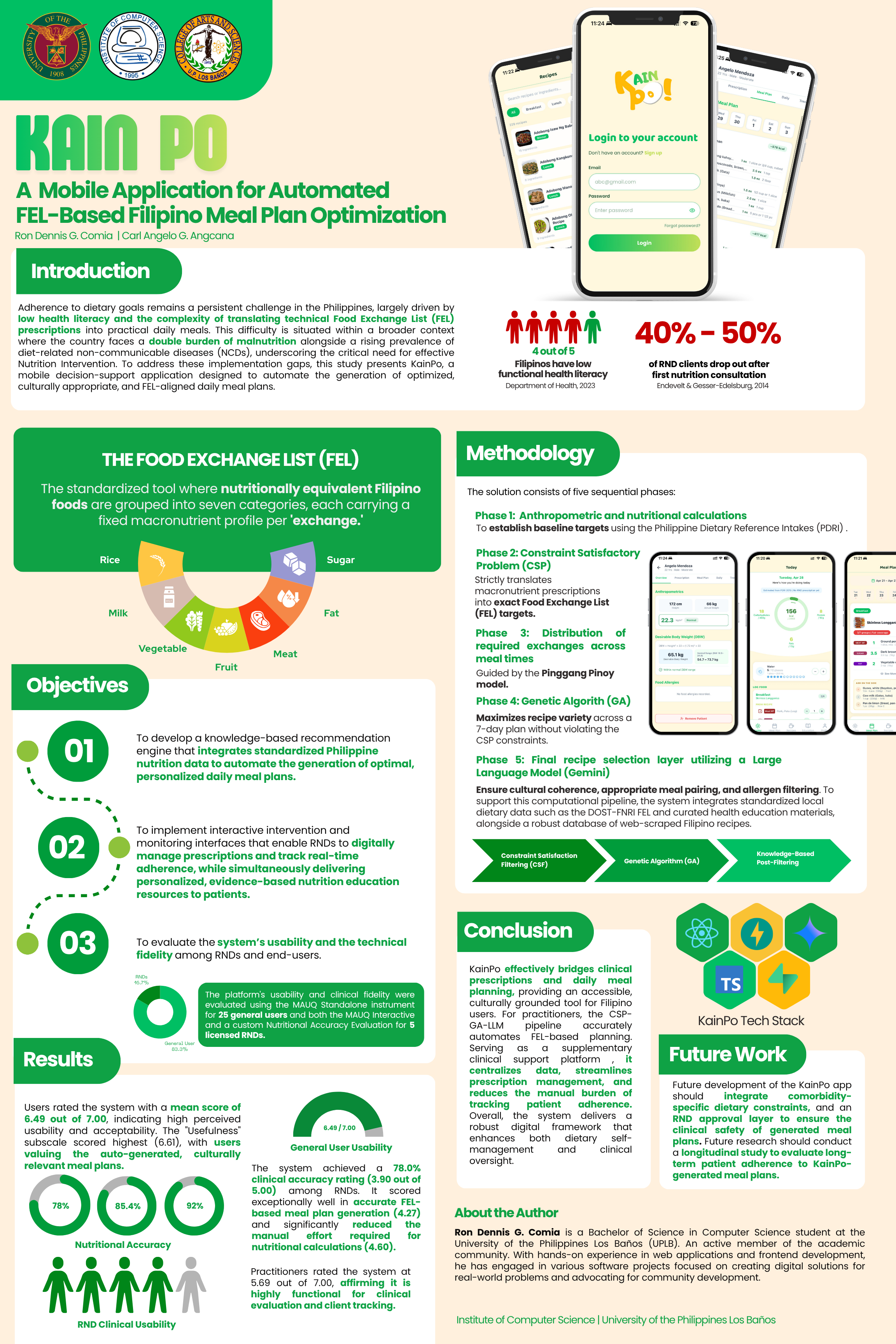
The development of KainPo was driven by the need to digitize and streamline the labor-intensive Nutrition Intervention phase of the Nutrition Care Process (NCP). To visualize user adherence and dietary trends without relying on third-party libraries, custom React Native components were developed for the interface. The backend architecture utilized Python and FastAPI to handle complex optimization requests, while Supabase provided secure authentication and PostgreSQL database management with Row-Level Security. To solve the challenge of automating clinical workflows, a five-stage sequential computational pipeline was developed:
Baseline targets are calculated utilizing the Philippine Dietary Reference Intakes (PDRI).
This foundational algorithmic layer translates macronutrient targets into strict daily Food Exchange List (FEL) prescriptions.
The system logically allocates the computed exchanges across five daily meals, guided by the Pinggang Pinoy plate model and clinical appropriateness rules.
To optimize variety and prevent dietary fatigue, a GA iteratively evolves the 7-day meal plan by rewarding weekly diversity and penalizing intra-day food repetition.
A comprehensive database of Filipino recipes was scraped from Panlasang Pinoy and mapped to FEL standards using a custom deterministic keyword classifier. Finally, the Gemini 3.1 Flash Lite Large Language Model (LLM) was integrated to select the final dishes, strictly enforcing cultural dietary rules—such as alternating between broth-based (sabaw) and stir-fried (guisado) meals, and preferring silog dishes for breakfast.
In an evaluation involving 25 general users, KainPo achieved a usability score of 6.49 out of 7.00, with users highlighting the intuitive interface and the convenience of culturally relevant, auto-generated Filipino meal plans. Clinical evaluators strongly agreed that the platform significantly reduces the manual computational burden required to calculate patient nutritional targets. The application proved highly effective as a supplementary clinical tool, allowing RNDs to manage multiple clients and monitor dietary adherence trends from a single, centralized interface. The project successfully introduced a replicable computational framework (the CSP-GA-LLM pipeline) to the Philippine clinical nutrition landscape, effectively bridging the gap between technical diet prescriptions and practical, day-to-day meal planning.